Showing posts with label homesteading. Show all posts

3.09.2011

Ginger pears (vegan)

For this I used mostly d'anjou and some red scarlet pears.

 As promised I am going to let you know what I choose to put up and when so you can see what goes into my pantry/larder.

I think that ginger is one of those things that rings freshness through the nose.  You FEEL it's flavor.  Like hot peppers, it is a bit of a physically undeniable experience that extends the tasting to a perfume.
I feel Ginger harkens excitement, awakening and makes things happier.  I once hated it and now am confused at how I could have possibly.

I am a big pear fan.  I feel like if I had a friend I'd want them to be an apple - a little more durable and robust, but a pear is a lover.  It takes a little more finesse and you must treat them nicer.  So isn't it lovely that pears have a very long season (variety to variety).  This means that they can get nabbed locally (for me) for a lot of months.  This makes me feel contented until their prices go up... then less so.  So preserving them is a good thing while they are cheap.  Cheap, FRESH, seasonal and local.

I looked through the giant catalog styled books of canning and found not a jot interesting enough to try out on the pears (other than pear butters, which require a lot more pears than I was willing to sacrifice).  So feeling a bit like Imelda Marcos needing a pair of sturdy hiking boots I went all internet on it and still came up short.  In which case the result is *&@% it, add cardamom and ginger - bang. Done.

I use Jelly jars for this recipe because it is potent and I can't imagine eating a lot in one sitting.  If you have a big family then Quarts may be the way to go.

You will need approximately 1 pear for every half pint (the little jelly jars) you use.  The yield depends on how packed you can get the jars with pear pieces.  It averages 10 half pints per this recipe of liquid it you jam them babies up well (making sure to leave just enough room to have the lids seat properly).  I got 20 jars from 18 pears and did the recipe below twice for that same amount.

5 - 6 Cups water
2 1/2 Cups vegan sugar - this is considered a "light syrup" I feel "light" is by old standards and seems really sweet to me.
8-10 cardamom pods
2 -3 twigs of cinnamon (I used real cinnamon not cassia bark... Ceylon/real cinnamon is lovely, delicate and smooth,  cassia is potent so you can use a lot less of it for this.  1 twig or 1 heaping tsp of cassia cinnamon.  If you don't know if your powder is cassia and you are in the US, chances are it is, if it says Ceylon then you know it isn't.  If it doesn't state this implicitly then it is cassia.)
3/4 inch knuckle of ginger root grated (This is plenty to bring the feeling and taste of ginger without a lot of nose heat, if you'd like more do it up.)
1/4 tsp nutmeg
1 lemon's zest

Bring water to a simmer - light boil, add sugar and whisk gently to blend into dissolving. Once dissolved add spices, zest and ginger. While liquid simmers and steeps peel and core fruit and slice into chunks and coat with a touch of lemon juice to keep them from browning.
In your clean jars add a 1 tsp lemon juice this will insure your fruit has enough acidity to preserve.
pack well with pear pieces.
Strain your very hot liquid through a sieve and fill jars with syrup leaving 1/4-1/2 inch room.
Lid and finger tighten then place into water bath's boil water.

I pre-warm my oven to 150-200
I have the jars rumble boil in the bath for at least 12 minutes then move the hot jars to a lightly warm oven 150-200 for 5 minutes... then move the jars to room temp until they cool.  This will help them cool down SLOWLY.  You'll hear the jars doing "things" and making sounds for the next hour and that is the jars sealing themselves into that vacuum to keep things tasty and pure for you.

Process your water bath as you normally do.  If you don't normally do this then I recommend you grab a book on the subject to fully understand it as food preservation is pretty crucial to get correct.  The rule is that you hear a "voop" sound when you open the jar to eat.  It not... that jar of stuff can make you dead sick, or just dead.


Pack your jars well so when the jar is sealed and the fruit floats there isn't a lot of room that is just syrup.


Serve these as a dessert alone or over ice cream, whipped cream, vanilla breads of a variety of sorts or a rich deep almost bitter chocolate thing.

I'm blowing your mind, I know.
...crickets...

2.28.2011

Stocking up wisely -- eating where you are


Some industrious women who kept their progeny healthy.

Planning for disruptions in the food supply chain is something earlier generations were all too familiar with.  Our modern day shipment system has lulled us into a false and dangerous sense of complacency since we're not actually more insulated from shortages than earlier generations -- we're less.  This is due to two major factors.  First and foremost, food stores and stores in general operate on a "Just In Time" delivery system.  This means there's not some secret warehouse out back with supplies when the shelves run out.  When a product is sold out, more must be on its way already.  This system breaks down catastrophically during periods of unexpected turmoil -- when healthy supplies are needed most.  The second reason why we're not better of is due to the fact that most people do not have a real pantry to speak of.  Here at Potlicker HQ, we wrote about this early on.  But that entry was not inclusive, and since that time, I have organized my thoughts on how best to organize your efforts.

A WWII leaflet that helped people make do and thrive on less.

Before starting into what we should stock up on, it's important to know why we should stock up on it in the first place.  A pantry filled with bottles of jam may be tasty, but if you had to live our of your pantry for say, 2 months, you'd literally starve.   So, what DO we need to have to be healthy?   Well, we need to mind two different factors: energy balance and nutrient balance:

Nutrients:
  • Proteins - essential to growth and repair of muscle and other body tissues
  • Fats - one source of energy and important in relation to fat soluble vitamins
  • Carbohydrates - our main source of energy
  • Minerals - those inorganic elements occurring in the body and which are critical to its normal functions
  • Vitamins - water and fat soluble vitamins play important roles in many chemical processes in the body
  • Water - essential to normal body function - as a vehicle for carrying other nutrients and because 60% of the human body is water
  • Roughage - the fibrous indigestible portion of our diet essential to health of the digestive system

And then the energy part, which is different for every person depending on things like age, size, activity levels and so on.  We all have a base metabolic rate, which is our baseline for minimum energy.  If we fall below intake of this, our body has to take it from our reserves or slow metabolism down, and that is not a good thing.

To do it right, we need a reliable balance or blend of energy forms in our diet that "burn" the right way -- just like any machine the fuel has to be right for the engine to function optimally.

Ideally that blend looks something like this:
  • 57% Carbohydrates (sugar, sweets, bread, cakes)
  • 30% Fats (dairy products, oil)
  • 13% Protein (eggs, milk, meat, poultry, fish)
So, this handy chart helps you know what to stock up and in what ratios.  But let's not stop there.  Fat is something that has a very bad rap in our society -- and undeservedly so.  Our brains require it to function, and it helps us store energy reserves for leaner times.  When we don't get enough of it, we lose our minds and starve to death.  No kidding.   In nature it can be one of the hardest things to obtain because it is such a complex structure.  And, to make matters more difficult, there are different kinds of fat as well.

All fats contain both saturated and unsaturated fatty acids but are usually described as 'saturated' or 'unsaturated' according to the proportion of fatty acids present. Saturated fats are generally solid at room temperature and tend to be animal fats. Unsaturated fats are liquid at room temperature and are usually vegetable fats - there are exceptions e.g. palm oil, a vegetable oil that contains a high percentage of saturated fatty acids.

And, carbohydrates have different forms as well;  starchy (aka complex) carbohydrates and simple sugars.    Honey is a great example of a simple sugar source, where potatoes are a classic starchy carb.  Both of these provide essential energy to muscles in the form of glycogen.  The starchy carbohydrates are the ones that have all the vitamins and minerals in them as well as protein. They are also low in fat.  The downside of them is their bulkiness may inhibit your ability to get enough energy from them.   Simple sugars on the other hand are fast-burning, high energy fuel.

Your digestive system converts the carbohydrates in food into glucose, a form of sugar carried in the blood and transported to cells for energy. The glucose, in turn, is broken down into carbon dioxide and water. Any glucose not used by the cells is converted into glycogen - another form of carbohydrate that is stored in the muscles and liver. However, the body's glycogen capacity is limited to about 350 grams; once this maximum has been reached, any excess glucose is quickly converted into fat. Ok, so this is all pretty technical, but here's where it translates into your pantry.

First, there are a few different what I call "vectors" to keep track of:
  • cost
  • locality (i.e. distance from your home base)
  • availability & seasonality
  • substitutes (your first choice should be natural/healthy, affordable, storable, and ideally local with a long shelf life)
  • importance and composition of the ratio above
 These variables will make up your own personal equation for stocking up.

First, let's talk about locality (distance).  In a short term crisis, this is not as essential because you're expecting the supply chain to be restored after some expected period.  In a long-term crisis, however, this variable is king.   I'll get into that more in a moment.  This will help you gauge your radius.

Availability and seasonality has to do with time of year and your particular location.  In some places you can't grow certain things.  This seems pretty obvious to some, but you'd be amazed how many people think a tomato in Winter is perfectly natural.  Thankfully, there are lot of different charts available about what is in season and when.

Substitutes are a way of determining first, second and third choice for your stock up goods.  For example, in the fats area it might go:  olive oil, pork fat, sunflower oil  in starchy carbs it might be: sweet potato, sunchoke, russet potato

Selecting your primary choices for stocking up is it's own entry, but use the vectors to help you decide.  So, healthy, natural, low cost, local, easily storable, long shelf life is best.


Victorian larder full of pickled sauces, preserves and spices.


Victorian cold storage with potted meats.
So, we need to create a chart that allows us to examine the various vectors in order of importance:

CARBS
FATS
PROTEINS

Then columns for each vector:
DISTANCE
AVAILABILITY
COST

In the availability column, we want to have a Y/N answer, meaning:  "could I or someone with land within 100 miles grow this here?"   Distance is simply how far away the thing is, regardless if you can grow it locally or not.  Cost is your own scheme, but I use High, Medium, and Low.  Also, be mindful of what would cost significantly more during a time of disruption.  Water is a great example of this.  It's cheap and plentiful until it's not, and then it is impossible to get and super expensive.

Next we plug in our favored sources of nutrition and energy into the fields like so:

CARBS

 NAME
 DISTANCE
 AVAIL
 COST
 CHOICE
 sweet potato
 local
 Y
 low
 1
 sunchoke
 local
 Y
 medium
 2


And so on...

Next, you look at the storage space you have and stock up in order that it appears in your list!  And, don't forget the all important salt, water and spices.  It's virtually impossible to have too much of that.  And, having a few luxury items around like coffee and chocolate might not be a bad thing either.

Lastly, you need to determine what type of disruption you are planning for.  Is it 2 weeks?  2 months?  a year?  forever?  In the last case, your pantry could tide you over until you can get food crops growing and animals raised.  And, when planning for self sufficiency, all of these ratios still apply!  Plan your own operations so you have multiple sources of each staple with the highest number of the most important thing.  It's how people have survived on potatoes and lard for generations.


We will keep you posted on what we choose to stock, why and how.
Things that I have on hand in a fairly large number at any time is :
  • Organic flours
  • Olive Oil
  • Home Canned Tomatoes
  • Sea Salt
  • Vinegar (easy to make after you acquire the mother)
  • Honey
  • Spices
  • Herbs
  • Dry beans (lentils of a variety as well)
  • Rice
  • Dried meat (yes, I'm serious)
  • Preserves (a variety)

Freezers are a luxury that should not be relied upon.  When the power goes out, so does your food.
If you want to really save freezer food I recommend the chest freezers as they keep colder longer by not letting all the cold air escape when you open them.  This is a big plus when the power is out and you need to get something out.

2.24.2011

Treadle Machine

A Ram's head drawer pull.

Like a lot of folks that are probably my age or older than me, I grew up in a home with a treadle machine.  I don't know the history of it; like how my mother came to own one, or if it was just picked up on a whim or if it was passed to her through a family member.  She used it consistently throughout my childhood.  Never making a fuss with it, but relying on it solely to repair anything or make something we otherwise could not afford.  It simply was a fixture, a tool that prettied up an otherwise unsightly space (our homes were a bit dismal).

Hers was a Singer 27/127 Memphis with the Sphinx decal.  I don't know the year but it is likely it was between 1906-1930.

I had some impatient lessons on it and never could get the damn thing to go in the same direction for any length of time.  The treadle rocks gently back and forth while the wheel (ideally) cranks in one direction (some odd ones roll towards you, most roll away).   Goodnight! My sister and I couldn't keep our mitts off the thing.  We were always screwing with it and got beat hard a couple times for doing who knows what to it.  I'm sure a thousand tangles had to be cut out of the threads and the tension was probably always a bit off because of our playing.  If was the most alluring of all the forbidden things in the house.

So since I've been thinking through a life and could be a world (You don't have to be right or left to see the system is botched) without electricity is completely likely.  Likely, at first by my own design.  So I went on the list making of all the things I would either miss or need should I not have electricity to make my life simpler.

Some resources for the new treadler and other treadle-lovers:

Donna Kohler  Taught by her grandmother the simple act of a close family activity gave birth to a teacher of what is now thankfully once again a growing population of people that don't just collect treadles, but also use them.  She sells a book for maintaining and rehabilitating your treadle through her site.
Dick Wightman - http://www.treadleon.net/ 
Treadleon is a community of treadlers that share with each other experiences of using, acquiring, maintenance, and basic love for the foot powered machines.
On his site is an excellent guide to getting the treadle suited to you.
A LOT, about an easy to acquire sewing machine. The Singer 27/127 
A blogger who uses treadles to make her things.  Huge diversity,  I'm loving the Indian Orange Peel arcs.


There are not many resources available but these few are enough to get you going and on your way to becoming an expert. 


I love the provenance, it has pretty much zero significance for anyone other than the immediate family members who know specifically each person named.


What I have and why I have this particular one.

1906 Minnesota A or a Minnie A.  The cabinet has 7 drawers (6 with flippin' ram's heads for the knobs!) and it came with all the attachments and a million (just shy of...) needles.  Which for this machine is a particular find since the needles can be tricky in getting.  The Minnie A has a longer needle than most machines. Who wants to order and wait for the right needle? boo. The price was a little high for ME.  At 100 bucks.  But I am in the most ridiculously expensive part of the nation and it still was more than a few excellent options.  The average great deal was between 50 dollars to 100 dollars all smoothly operable machines just in need of people that will love and use them.  Antique stores almost always call things rare that aren't and have prices on them that reflect their statements and not often the machine's worth. Silly enough the more expensive I found, the less operable they were.  I have no clue what gives with that.  I suppose folks who are trying to pay the mortgage with outmoded objects?  I didn't need a boat anchor.

I got mine from Craigslist from a more than reasonable person!  Your treadle should not cost you more than 120 bucks.  The market from most reasonable folks' standpoint is plain and simple.  A trumped up ponzi-scheme.  The housing market which made credit and the credit life seem like everything would grow in value forever has imploded.  You can't have infinite growth in a finite space.  So collecting isn't of much use when people are losing their shirts.  Just get a good machine that requires only your sweat and maintenance and you'll at least be able to sew shirts for yourself.  Folks who say it is worth "blah blah blah" are usually blowing smoke for the most part because it shouldn't be a shelf for a big bowl of fobs.  It should be your sewing machine!  And worth to a person who is using rather than collecting has a much different perspective.  Everything is worth precisely to the penny what someone is willing to pay for it.

I CRINGE when I see sewing machine cabinet drawers for sale, or worse just the treadle iron with a slap of wood over the top. This obsession with shabby chic has made everyone into Fred Sandford.  DO NOT BUY A MACHINE WITHOUT A CABINET!!! It simply isn't worth the headache. Often these are folks who've come into the machine head have either obtained it without the cabinet or worse... sold the cabinet as a friggin' table.  Wagon wheels look best ON WAGONS sure they mark a lot of driveways but it would be best that the working wheels weren't tossed on the end of every driveway.  Like there aren't enough tables in the world?  Perhaps that is just me?  The sewing machines that are easier to get cabinets for are mainly Singers.  But it is better to start with a whole machine and go from there otherwise you have to make it fit the table and that is often near impossible.  And second would be to have a singer cabinet and then a singer head.  You can forgo all this mess by getting a handcrank machine!  Handcranks are awesome for teaching children to be people powered!

The handcrank machines are far fewer and the prices are even more wild... anywhere from 50 - 1000 bucks.  phew!  I know less about them other than their ease of use versus learning the finesse of the footwork required on the treadle machines.  I believe you can convert treadles to handcrank and to electric models (misses the point of sewing without power then). 

Make it happen!  Whatever IT is.

1.02.2011

Kitchen gear


I rarely buy utensils.  I  mainly use pots and pans that have the ability to be included in my will.  I have never treated myself to good towels or good potholders.  My kitchen was filled with not only delicious baked goods, but a lot of cursing.  I burned my digits every time I'd reach for something! Until now...

I have the best potholders I have used to date.

My New Year's resolution is FUNCTION!  To buy only things which I need, have function and can help me be a taskmaster.  

The potholders were made with love and care in South Dakota.  South Dakota?  Yep.  I'm not big on shipping things all around the globe, but hell, IKEA ships things from factories in the poorest countries in the world to their giant box stores all over the globe in the "developed" countries so it seems silly for me to split hairs and have guilt about getting some upcycled ones sent directly to me from the maker.

The kind lady who made them has a store, Pieces Of Olde, where you can get many other things she has made.  I selected the potholders because I'm a sucker for function.  There are aprons and other home lovelies there. The totes and pillows are really nice for the folks that like the full imagery of the feedsacks -- which are usually full of visual interest, nostalgia and tenderness.


The potholders are made from feedsack, ticking and other vintage fabrics.  They are cotton and frankly, wonderful. The potholder section of her store. 
Mmmm look at that butter colored pair!  Be mindful of dimensions when ordering.  I'm certain you'll love them.


Available still at Pieces Of Olde

Whether pulling a lasagna or bread from the oven, my hands are thankful for her hard work.

10.31.2010

Bar B Que (Not just for meat!)


The best thick sauces are made with paste tomatoes.  You can use a canned tomato puree or "crushed tomatoes".  But if you go the from scratch route you must cut tomatoes in half and squeeze or scoop out the seeds and more importantly the soft slimy covering to the seeds. Short of fermentation the seeds and slime bits take forever to break down.  The soft stuff around the seeds are what give the bitter acidic tangy flavor to tomatoes so if you want to have sweeter smoother sauce you get rid of that part.  It is also the part of the tomato that breaks down protein so expelling it makes your bbq last longer.

For one 4-5 lb chicken (this will make approximately 5 Cups finished sauce) baked and stripped down  this is the amount of bbq sauce you'll need for a saucy dish.  You can halve this if applying to grilled foods or using as a glaze while baking.  I like this with Pici pastas. num

  • 4 pounds of Tomatoes or one 28oz can of tomatoes
  • 1 giant (and I mean huge) yellow or vidalia onion minced (teeny tiny pieces) - this adds a lot of round and sweet flavor one of the more important ingredients
  • 4-6 cloves garlic pressed or minced
  • 1/2 Cup olive oil
  • 1/2 tsp cayenne (depending on heat-taste)
  • 1 tsp black pepper
  • 1 tsp paprika as real as you can get not just the stuff that makes things red (smoked paprika makes a unique bbq)
  • 1 tsp allspice
  • 1/2 tsp cumin (fresh ground is best)
  • a handful of fresh oregano
  • 1/2 -1 Cup honey, agave, brown sugar or Preserves of your choice (cherry, and raspberry are my personal favorites- apricot is also awesome)  I use Bonne Maman or whatever I have been given or have canned myself.
  • Sea salt to taste 

Simmer minced onion until translucent, add minced garlic and stir well.
Pour tomatoes into onion/garlic mix simmer on low-med (it should not spit and sputter too much that scorches the sauce). Add spices and then herbs, once nearing the end choose one sugar/sweetener.  Stir in until well blended wait a few minutes to taste before adding final salt -the flavor builds and you can end up with a salty mess if you salt too quickly.  This recipe can be halved easily to be a dip for chicken fingers, fries, sandwiches.

This recipe can be canned or frozen into portions so you don't have to baby a new sauce each time you want some.  If canning add 1 tsp of lemon juice to a half pint,  2 tsp to a pint, 2 TBSP to a quart jar.  Or just test the ph.  I like to just make it easy on myself and add the lemon juice in these increments, it assures there is enough acid to help preserve the sauce.

10.24.2010

Blackout friendship


I grew up poor as can be.  Of course as kids we had zero clue and played and carried on like animals.  We knew our clothes were ugly but we were ugly too - so no one was looking.  We had a few strong rituals that made for powerful memories.  When the power would go out we would become a family.  We were of course a family already, but primarily my sister and I ran around outside and played in junk yard heaps.  When there was a power outage mom would get the oil lamps and light their woven wicks and do up the largest room in the warm amber glow.  There we'd sit and talk, really talk.  Joke with each other, about how much we hated each other - or at least it was a joke then.  We duke out some epic games of Skip-Bo and then after laughter and love.  The lights would pop back on.  Whelp, done.  Everyone go back to pretending we are all alone in life.

Recently in my neighborhood there was a power outage.  Everyone gathered on their porches looking up and down the streets.  Each shouting to the house across about what the hell was wrong with the power company and how awful the service was ( The power has flickered MAYBE twice in the year I've lived here- no complaints from me).  Jason and I gathered candles and ran to the porch elated. Watching the neighbors talk at length, giggle together and children frolicking hard like summer fawns.  It was incredible.  Everyone had a candle flame either on their porches or in their living rooms.  You could see every star.  There was a harmony in the neighborhood that was rivaled only by the saccharine joy of woodland creatures in a Disney feature.

At 10 PM on the dot the power kicked back on and a roar of clapping and hollering thundered throughout the neighborhood.  In an instant every one was "happy" after being so happy.  Now they could go back into their caves and turn on their cave-shadows.  No need to be friendly.  We're good, we have Netflix.  New episode of House on Hulu.  Now we could be really happy because we could escape how sad we are and not feel anything at all.   With the clapping my spirit melted and I sat on the porch with Jason until it became a little uncomfortably cold.

10.22.2010

Vanilla Ginger Mint Ice cream


Remember the directions from the Pumpkin Ice cream?  That will help with the how.

What you need:

  • 1 pint half and half
  • 1 scant TBSP vanilla
  • 2 handfulls of fresh mint (of your choosing) chopped fine, or use mint oil
  • 3/4 inch fresh ginger grated
  • 1/3-1/2 cup Vegan sugar 
Whisk together ingredients vigorously then continue to your favored method of ice cream making.  (click the Pumpkin Ice cream link for the two I use)

Apple Ginger Acorn Squash


I have to straddle a fine line to eek some ginger into my life because Jason doesn't like it unless it is soda and even then he likes it far more tame than I prefer it.  This is a good dish to get a ginger fix and still have a lot of savory other things happening to keep the slightly more finicky tongues busy.

What you need:

  • 1 large or two small acorn squash
  • 1 granny smith apple (peeled and cored then diced in chunks)
  • 1/4-1/2 inch little knuckle of ginger
  • sea salt to taste
  • cayenne (optional)
  • a clove of garlic (optional)
  • teeny pinch nutmeg (optional)

Preheat your oven to 375.  Oil lightly a pan.  Make sure your acorn squash either does NOT have wax on the exterior or give it a scalding rinse/scrub.  The food wax is the worst.  And if you're in a hurry when buying food it is really tough to see it.  Scratch it with your finger and if you reach the real skin in the scratch, great!  If not, this is very thick wax and may need to be cut off!  It is always best if there is NONE at all.

The easy way to cook squash is to cut it in half, scoop out the interior squish (reserving seeds if you're a gardener in case this is the best squash of your life) place the flesh side down on the pan and bake forever.  Checking every 20 minutes, then decreasing checking time to 15 and the closer to done then to 5 minutes.  It is not a rigid science with the huge variety of sizes these come in. You can't do this method if the wax is stubborn.  It will run down the sides to your pan and then it is on the flesh.  You can skin the squash with a peeler and knife for the crevasses. This way seems painfully intense but, you can then cut 1/2 inch rings and chop the squash into little pieces and it cooks really quickly.


After the squash is half way done... smaller pieces are effortlessly pierced with a fork.  Now it is time to add the granny smith chunks to the pan.  Cook for another 15 minutes until the outside flesh of the apple chunks have a silken but sad looking skin. It should now smell like autumn, and be sweet.

Place cooked lovelies into a tall mixing bowl with abrupt sides (this will keep things from flying out) and using a mixer blend until squash is mashed potato like -apples may most likely remain in chunks and not smooth through.  This is preferable.

You can keep this in an oven dish in a warm oven if it is completed before other things in the meal because this will lose heat quickly!

I served the squash with this:


I slice up some garlic and sautee it in a pan on a low-med heat until golden brown and crispy and then put aside.

I shredded a carrot finely into the remaining oil in the pan and tossing them often I let them darken and then removed them and put aside.


These are Heritage Pork chops which were cooked purely in their own fat, no oil or butter and some paprika I dried and ground from my garden.  After the pork chops are done -they only take minutes to cook and if put into a nice already hot cast iron skillet you are just cooking them until there is a nice caramelizing on the fat of the pork (a good chop will be marbled with fat and may have the caramelizing on the "fleshy" parts as well.  If you like your chops a little well done and cook them a couple minutes (on both sides)  just give a tiny slice to the meatier part on the outer edge.  This slice will firm up and open up looking like a triangle was cut out.  This is a "well" cooked chop.  I prefer mine to still expel a great deal of moisture so I do mine about medium -just touching it with my cooking fork in the center of the meat for firmness and using caramelization as the guide.  A good pork chop will have a PINK tone to it.  It will not be white. The Other White Meat is a campaign for cheap industrialized factory farmed pork. 

After the pork is done I put a TINY amount of butter in the pan which takes a little of the pork drippings off the pan and then I add a handful of pineapple sage cut chiffonade and stir it into the butter until the sage wilts.

I place the sage and garlic chips over the pork.

And a final Pork porn shot.

10.20.2010

Pumpkin Ice Cream - It is never too cold for delicious

Traditional method used and then frozen in a freezer that is on a lower setting, making it scoopable! YUM

Traditional method used and then served immediately.  Like soft-serve.  Yum!


I'm not a gadget person.  I have a small electric hand mixer that comes out maybe 4 times a year even though I cook about 800 times a year.  I fail at knowing anything new and usually sit with a puzzled look when folks talk about such toys.  I'm the one who always thinks "WHY DOES ANYONE NEED THAT!?" (yes, sometimes in appalled anger) A mixer, sppfff, a spoon - I have 4 and they are easy to clean.  Well, I fell for the marketing trap of the Play and Freeze.  I wanted it and longed for it.  I called every store in the 15 mile area around me.  I pined for it but couldn't spend 30 or more dollars to order it.  Not finding it anywhere I gave up and shrugged off my "need" for it.  Jason kept insisting we could make ice cream with "just a can and a bowl"  but the initiative was never taken to make it.  UNTIL NOW!!! Yeah!

What you need for 1 quart (breaking it up into two batches cuts the time on it and it will keep in the fridge for a week easily):

  • 1 pint /You will only NEED 1/2 of this but can easily use all to stretch your ice cream/ half and half (a local dairy and raw is best... but I know the system makes it tough) **{{also! you can make pumpkin pie sherbet or vegan ice cream skipping the cream}}
  • 1 small can of pumpkin 15oz.  or a single 2 lb pumpkin cleaned, cooked, scooped and pureed(You can replace with sweet potatoes, a lot of folks that dislike pumpkin pie dislike ginger - I find it indespensible but? Personal taste, also sweet potatoes are more readily available.)
  • 1/3-1/2 (My sugar amount- Jason and most peoples sugar amount) Cup vegan sugar or light brown sugar or maple syrup
  • 1 tsp vanilla extract
  • pinch nutmeg
  • 1/2 tsp cinnamon
  • 1/4 tsp allspice
  • tiny bit of grated fresh ginger (use a fine grater and give it a swipe or two fresh is powerful, dry is often mixed with other nasties)
  • 1/8 tsp or tiny pinch ground cloves (very strong so go lightly) 
  • 1/4 -1/2 Cup of rock salt (it may say ice cream salt)  I got some for .99 cents and since it is only for speeding up the melting of ice because melting ice has more freezing capability and you don't consume the salt so you need not be as picky as if you're feeding it to others.
  • A large CLEAN coffee can or quart mason jar.
  •  A large bowl or pot which the ice cream can/jar fits well inside of with plenty of outside room for ice.
 The more fat there is in the milk, the quicker it will fluff and freeze, but I don't use anything fattier than half and half because it works really well in the play and freeze for traditional method (shown in photos) fattier cream could cut back active time.  **If you mix everything except the cream into the pumpkin (spices)  then put into the freezer for a few minutes taking it out only to stir and set up the rest of your situation, then it being cold will jump start the whole thing.  If you're making the vegan version I would recommend cutting back on any strong spices just a touch as this is a potent mix meant for flavoring the cream as well.  When storing it you may want to turn your freezer down a touch so it isn't so cold.  High settings on freezers just make ice cream into concrete. For vegan version you can stick it into the fridge and just come back to it later... taking it out of the freezer placing it on the counter for a few minutes to loosen the edges from your container.  Voila!  If you want a fluffy version continue below ignoring the cream.


Traditional method:
In a mixing bowl whip together your sugar, spices, cream and pumpkin then pour/scoop into the can or jar.  (or place in freezer to chill first) The bowl must be large enough to house the ice and the coffee can/jar.  Can/jar goes into the center of the bowl.  Surround the can with ice. Sprinkle 1/4 Cup rock salt over ice. Reserving some salt for next ice batch should your ice diminish before you have the consistency of ice cream you want. Now with the can/jar in the middle of the ice just agitate it like a washing machine.  Swishing back and forth or turning it in your desire direction mix it up.  Doesn't matter as long as it is moving and touching the ice. Ice level should be above the level of ingredients in the jar.

If you have the play and freeze just follow directions they include.  ( It is a pain in the poot to get ice cream OUT of it if you don't stop to stir it - you must stop a few times and stir it to remove the coldest from the walls) It will take about 20 minutes of active rolling to complete ice cream using half and half in the play and freeze.  It makes a fairly firm ice cream.

Still runny, but with plenty of solid pieces to mix in.

Starting to get larger amounts of solid frozen bits.


For the bowl method, you will also need to occasionally stir it with a spoon.  The walls will get the coldest first... so it can create an ice wall making it tough to mix in.  So stir pulling ice cream from the walls to the center and check for the consistency you want.  Once you have that... you have ice cream!
Depending on the fat in the cream and the salt in the ice this can take between 30 minutes and 55 minutes of constant motion! It makes a soft ice cream.

For saving the excess I recommend dialing down the freezer so it isn't crazy cold and turns your hardwork into concrete. To serve remove from fridge and let it sit out for a few minutes to release itself from the container.

My review of the play and freeze is that making the children do the heavy lifting portion of the ice cream making is genius.  The downside is having to stir it so often.  The quality of firmness is pretty rad as well.  Enjoy your ice cream adventures!

7.12.2010

Potlicker editorial: Differences disappear the closer you are to the land

My dad was from a truly different generation.  Born in 1914 in a small mining town in Arizona, he endured the great depression, the second world war and many other hardships.  He had a very strong pragmatism that developed from his upbringing, and so did most of his friends from the same era.  Through his later years, my dad returned to the cowboy life he loved so much throughout his youth, and I was lucky enough to spend a lot of time with him on his ranch during the hot Arizona summers (my parents separated when I was very young).

When I was younger, I never really thought about my dad's political bent.  By today's standards, he was probably a staunch conservative, as he was fiscally restrained, believed in hard work over hand outs and owned more guns than you could count.  But, somehow, he didn't seem closed minded or judgmental about the way other people lived.  When he spoke with people, it was usually about his horses or cows, the weather, the past, or some thing that might have happened that day while he was out on the land.  He had some amazing stories, and I would listen to them with complete attention.  That was another thing about my dad -- when he spoke, you listened because it mattered.

As an adult, I have been steadily trying to build my life so that I may live much closer to the land, as my dad did, and even more as my ancestors did.  I have been learning and doing as much as I can to be self reliant, understand natural systems and the ways people made due when food or water was scarce.  This has in turn lead me to read all sorts of blogs, forums and magazines with information about primitive living, homesteading, native crafts and traditions, food preservation and so on.  A curious side effect of this effort was discovering that people of all walks of life are interested in going back to the land, and that the closer you get to actually doing it, the less things like conservative and liberal seem to matter.   Living a subsistence life means preoccupying yourself with things of substance like meals, conservation of money and natural resources, family, and learning.  The more primitive the life, the less room there is to think or even know about fads, celebrities and even politics.  The land becomes a unifying force for people and when you depend on it for your survival, it's hard to tell a hippie from a CEO.  In nature, all people are equal and nature always holds the winning hand.  Civilization gives us the impression that we are above this truth, that we can conquer nature through our science and innovation, but this fallacy is contradicted every time a natural "disaster" happens.  Nothing we have created can withstand these forces.  In antiquity, people knew this and respected its awesome power.

Now, we're at a critical juncture in human history where increasing resource scarcity coupled with high population density is straining the very complex systems we have put in place to hold ourselves above the ever-rising effluence we have created.   Once those systems break down in earnest, we will be thrust violently into the world we're trying to escape.  When the store shelves are empty and there's no gasoline, what are people going to eat?  At that desperate moment, a Monet painting becomes less valuable than a crust of bread, and celebrity is nothing but a reminder of the hubris we once had.  Politics evaporate as well, and what is left are human ethics forged in the moment.  Do you share your food with the starving person next to you, or not?  Do you teach those around you what wild edibles are available, or do you keep it to yourself so it is not consumed by everyone else?  In moments of crisis, ethics and ideals are not generalized in any way.  They are hyper-specific and based on circumstance.  The differences that divide our country now would disappear in a heartbeat if the systems we depend on stopped working, and those who would seek to control our behavior know this.  They depend on it.

Imagine what life would be like if people were simply living and focused on things of substance instead of what Brad and Angelina were wearing.  I believe our future may well hinge on this proposition.  If we don't take a step back and work intently to rejoin the land and work with it instead of against it, we are going to incur a level of human suffering that has never been seen before.  A homestead or natural living space is a gift to future generations.  A nuclear power plant or dammed river is a curse to them.  Will our legacy to our children's children be Swiffers or the knowledge necessary to make a broom from what wild things grow around them?  Will they be expert video gamers or have the self reliance to find food anywhere they go?  Which is the greater gift?

On the land, we are all united.  On the land, we are all one people trying to not only survive but thrive.  And, contrary to what civilization tells us, thriving is not owning a sports car or a swimming pool; it's knowing that no matter what -- you can provide for yourself and your loved ones, and that future generations will thank you instead of shaking their heads in disbelief at your shortsightedness.
--------

The author of this Potlicker editorial is Jason DuMars, musician, writer, artist and activist.  He has been an active supporter and promoter of local, seasonal eating, community development and sustainable living.  In 2007 he was a leader in the groundbreaking "World Without Oil" alternate reality game and his contributions have been included in school curriculum associated with the project.   Jason is usually behind the camera for Potlicker posts.

6.12.2010

On the bookshelf.

I have a lot of favorite things.  Probably more than is allowable by the definition of favorite.  I just want to share with you things I think are inspiring, insightful, helpful, and useful.

Book list:
Recipes, gardening, and harvest
  • The Encyclopedia of Country Living by Carla Emery (has everything from basic recipes to how to make soap or how to process food for home use, livestock care or how to profit from what skills you acquire from living in a basic way but this book is mostly a recipe and helpful hints/tips)
  • Smoking Salmon & Trout plus Canning, Freezing, Pickling & More by Jack Whelan.  I like the spiral binding far more than standard. This book it the most thorough on the subject I've found.
  • Backyard Homestead  produce all the food you need on a quarter acre! by Carleen Madigan  If you don't own land but you rent or own a little bit, this book can help you organize to maximize what you yield from it. (This book is best for the ambitious home gardener and even includes some recipes this is highly recommended to someone who wants their home to reflect the way homes once were but without necessarily having to give up city life) 


    Inspiration for the person wanting more than the rat race
    • On the Farm by Jimmy Doherty.  It is his journey through getting a defunct farm, restoring it and making it into a farm of Heritage livestock and an organic organism again. This is mostly an inspiring story and not a step by step of how best to deal with all lays of the land in any specific way.  More of a one man's journey kind of story.


    Living off the land from what it gives freely

    • Native American Ethnobotany by Daniel Moerman This book is really intensive study.
    • Natural Dyes and Home Dyeing by Rita Adrosko This contains recipes to yield natural dyes, very plain speaking.
    • Basic Butchering of Livestock & Game by John J. Mettler JR. DVM , If you're disgusted by the meat industry and don't want factory animals and wish them to have quality lives with quality food then a book on how you plan on getting them to the table could also be in order.  The closer you are to your food, the better it is.  If it is organic produce shipped from China chances are it is doing a lot more harm than good. 
    • Edible Wild Plants by Thomas Elias & Peter Dykeman This is organized by season which makes the search a bit simpler.
    • Peterson Field Guides Edible Wild Plants Eastern and Central North America by Lee Allen Peterson
    • Food Plants of Coastal First Peoples (for folks on the Western side) by Nancy J. Turner
    • Tom Brown's Field Guide to living with the Earth  This is written in a way that at times feels heavy handed although I believe he is genuine.  I think it is my bitterness that I may be imposing on his writing rather than him.  The information is accurate and thoughtful.  This is the most philosophical of the books mentioned in this entire list.


    Building shelter
    • Cordwood Building the State of the Art by Rob Roy - If you have a chunk of land a tree equals a house.  How to make a home out of what most people use for firewood.


    Lost skills, tools, and arts
    • A Museum of Early American Tools by Eric Sloane The most thorough and especially for its small size of early American tools and more importantly how they were used, crafted and replaced - other books on the subject leave all that out.  The illustrations are lovely.
    •  Back To Basics a Complete Guide To Traditional Skills by Abigail Gehring This book goes into good detail of the how to for a project, skill or an art.  From felling trees, making water pump itself, spinning wool or hooking a rug.  The book by the same people about Homesteading however is a let down. With only a very brief overview of what this book seems to be able to cover in a more concise way and with further breadth of topics.
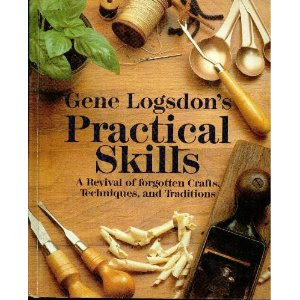
    • Gene Logsdon's Practical Skills  This is a favorite, the illustrations are beautiful;simple and quite easy to understand.  The projects even the more complex ones seem really obtainable through his gracefulness.